Germany has 3.1M+ students and under 250,000 purpose-built beds — a 1:12 ratio. Mannheim's ~100,000 students are served by only ~3,000 state-managed rooms. Private PBSA is virtually absent.
Existing 4-star hotel structure eliminates greenfield risk. Foundations, MEP infrastructure, and planning baseline already in place — reducing time and capital at risk versus new-build.
Germany's PBSA market is 15–20 years behind the UK. Entering now — before institutional cap-rate compression — secures development yields with a clear path to core exit at 3.5–4.5%.
At sub-8% institutional penetration, Germany is among the least developed PBSA markets in Western Europe — while hosting the continent's largest student population. The gap is structural, not cyclical.
Senior debt sourced by Dry Capital from German construction lenders and/or specialist PBSA debt funds at 50% LTV. No mezzanine tranche — equity gap closed by LP equity. GP seed contributed by 3iPro.
PBSA is now the single largest category of direct real estate investment in EMEA — not logistics, not offices. Institutional capital has rotated decisively into living. Germany is the last major market where entry yields remain compelling.
Germany's PBSA yields are 80–120bps above mature markets. Development yields in the right location can reach 6–7%. That gap represents the institutional entry premium — and it is compressing.
Mannheim's famous grid plan gives every city-centre block a precise address. F7 sits at the geometric core — pedestrian zone, steps from every transit node, within walking distance of five universities.
The Mercure Hotel sits at the geometric heart of Mannheim's famous Quadrate grid — within walking distance of every major university, the Hauptbahnhof, and the pedestrian zone.
Feasibility study launched — preliminary design ("Vorentwurf") April 2026 — converting the Mercure Mannheim, a well-maintained 4-star city-centre hotel, into Mannheim's first institutional-grade PBSA scheme. Two variants under study.
Modern PBSA students expect more than a bed. The programme competes with premium private-sector operators across Europe.
Safety and study environment are non-negotiable for modern PBSA operators and their institutional investors. Well-lit corridors, secure single-point access control, and spaces designed for all-night studying are specified from the outset — not retrofitted.
A classic German "slab tower + cross-block ("Scheibenhochhaus + Querriegel")" — an L-shaped massing of a taller north-south slab tower (OG1–5) connected to a lower east-west cross-block (OG1–3). Section geometry taken directly from the 1:250 preliminary design ("Vorentwurf") drawings and verified against existing building photography.
Source: Accor / Mercure Hotel Mannheim am Rathaus (F7 5–13, hotel code 5410). Floor level lines derived from preliminary design ("Vorentwurf") floor heights (EG 4.5m, OG 3.2m each) and calibrated to actual building photograph. OG4 and OG5 visible only on Slab Tower ("Hochhaus") — Cross-Block ("Querriegel") roof is at OG3+1 level, becoming the Roof Terrace ("Dachterrasse").
South-facing garden facade of the Cross-Block ("Querriegel"). The ground floor hosts the existing hotel restaurant + terrace — converting to student common room / social kitchen in the PBSA scheme. The Cross-Block is 4 floors total (ground floor + floors 1–3) as confirmed in the preliminary design ("Vorentwurf").
Double-loaded corridor in both wings. cross-block ("Querriegel") roof becomes roof terrace ("Dachterrasse") accessible from slab tower ("Hochhaus") OG4. Both wings share identical room depths (~5.5m) and floor-to-floor heights (3.2m upper floors).
| FLOOR | WING | ROOMS | HEIGHT FROM GRADE | NOTES |
|---|---|---|---|---|
| EG | Both wings | 0 – 11* | ±0.0 → +4.5m | Lobby · Co-working · Restaurant · Fitness · Bicycle store · *Variant B adds 11 rooms |
| OG1 | L-shape — both wings | 46 | +4.5 → +7.7m | Slab Tower ("Hochhaus") W+E + Cross-Block ("Querriegel") N+S — full L |
| OG2 | L-shape — both wings | 47 | +7.7 → +10.9m | Typical floor — confirmed in preliminary design ("Vorentwurf") OG2 floor plan |
| OG3 | L-shape — both wings | 47 | +10.9 → +14.1m | Top of Cross-Block ("Querriegel") — roof becomes Roof Terrace ("Dachterrasse") above |
| OG4 | Slab tower ("Hochhaus") only | 23 | +14.1 → +17.3m | Above Cross-Block ("Querriegel") parapet — Roof Terrace ("Dachterrasse") accessible at this level |
| OG5 | Slab tower ("Hochhaus") only | 17 | +17.3 → +20.5m | Top floor · Communal rooftop terrace ("Gemeinschaftsnutzung") at south end |
| TOTAL | 180–191 | Variant A: 180 rooms (commercial EG) · Variant B: 191 rooms (11 EG rooms + student kitchen) | ||
Source: preliminary design ("Vorentwurf") by bb22 architekten + stadtplaner for 3iPro GmbH, April 2026. Floor counts as annotated in drawings. Cross-section geometry cross-checked against existing hotel photography (Accor, hotel code 5410). This document is confidential.
The most consequential design decision in the preliminary design ("Vorentwurf"): Variant A optimises for amenity and revenue diversification at ground level. Variant B converts 11 ground-floor bays into student rooms, trading amenity space for direct rental income. This is an irreversible planning choice with material NPV implications.
Variant A sacrifices 11 rooms on the ground floor to accommodate public facilities. Before committing, the key financial test is whether gym membership revenue offsets the rental income of 11 annual tenancy contracts.
Var A only makes sense if the canteen + gym generate blended revenue ≥ €99K/yr, OR if the amenity premium justifies higher student rents across all 180+ rooms.
The industrial kitchen in Variant A implies professional catering or canteen management — a significant ongoing operational burden compared to the student-managed kitchens in Variant B.
The repetitive room layout on upper floors is a direct consequence of the existing hotel structural grid — a constraint, but also a conversion advantage. Room widths (~3.8–4.0m) are dictated by existing column bays.
Ground floor plans from preliminary design ("Vorentwurf") by bb22 architekten + stadtplaner for 3iPro GmbH, April 2026. Revenue analysis is indicative only based on assumptions of €750/month student rent. Gym revenue estimated at market franchise rates. This analysis is confidential and for investor discussion purposes only.
Three spatial moves transform the Mercure's existing fabric — lobby, hotel room module, and south courtyard — into a competitive, community-first student home in central Mannheim.
The large ground-floor volume is activated through furniture zoning rather than fixed partitions — café, quiet study, and group-work areas within a single open plan. Acoustic ceiling baffles, warm oak, and polished concrete reference Mannheim's industrial character while ensuring concentration-grade speech privacy.
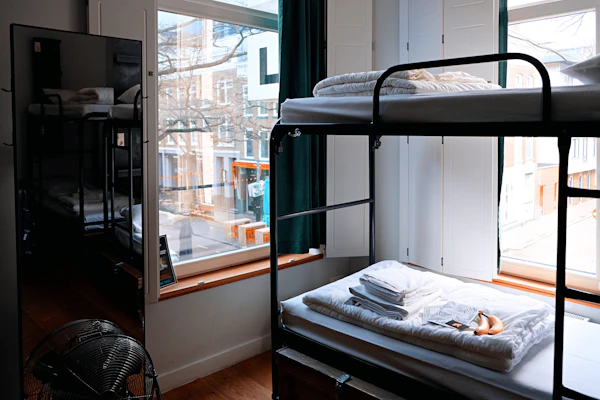
Bespoke joinery — lofted bed, integrated desk, built-in storage — treats each converted hotel room as a compact, efficient pod. Light-toned finishes and mirror placement amplify the single window's daylight deep into the room. Small private spaces shift the value proposition to the shared amenities floor.
The south courtyard links directly to indoor common areas — outdoor kitchen and terrace connecting to gaming lounge and social spaces — creating a continuous social circuit. Integrated landscape lighting keeps the space safe and active after dark, a material amenity for students working late hours.
3iPro is seeking growth capital to fund the Mercure Hotel conversion. Dry Capital is proposing to act as exclusive capital advisor — subject to mandate letter execution. Structure: senior debt + LP equity + GP seed (3iPro), with 3iPro as GP and Development Manager.
Senior construction debt sourced by DC or project finance lender. Equity raised via Dry Capital placement. 3iPro contributes as GP and lead developer — no mezzanine tranche.
"Dry Capital would like to act as exclusive capital advisor to 3iPro for its future growth capital — beginning with the Mercure PBSA conversion in Mannheim."
We source and structure both debt and equity — from initial feasibility through to financial close. Subject to mandate execution, our engagement covers this transaction and, longer term, the full 3iPro development pipeline.
We source LP equity from our proprietary network of institutional investors and family offices. Full process managed: NDA → data room → term sheet → close.
We source senior construction finance from German lenders and European PBSA specialist debt funds. Debt and equity processes run in parallel — minimising blended cost of capital and maximising returns for 3iPro.
We advise on the full capital structure: JV / SPV formation, waterfall mechanics, GP/LP terms, and development management agreement. We ensure the deal is bankable and investor-grade before any introduction is made.
We build the project DCF, sensitivity analysis, and investor return model alongside 3iPro. This drives all debt and equity term sheet negotiations — a prerequisite before any capital is introduced to the deal.
The 3iPro Mercure mandate sits alongside three live capital-raising processes currently being run by Dry Capital. All are confidential. Shown here to evidence that we are an active advisor — not a broker starting from zero.
New GP in exclusivity to acquire 9 operational care home sites across the Madrid region. DC is leading equity placement. One equity provider at final term sheet stage — close expected H2 2025.
New GP raising its inaugural avocado and specialty crop fund targeting Spanish institutional farmland investors. DC is running the full LP placement process across DACH and Benelux family offices with an agricultural mandate.
5th fund from an established impact GP. European brownfield-to-residential strategy with Article 9 classification. DC is leading LP placement for the new vintage across impact-mandated institutional investors and sovereign-aligned family offices.
Dry Capital has active relationships with equity and debt investors across this transaction type. Specific names and terms are shared under NDA only. All introductions are subject to investor suitability and mandate letter execution.
Institutional fund managers, PBSA operators, and specialist living-sector investors. These firms have been engaged by Dry Capital across prior transactions in German and European real estate.
3iPro GmbH is a Mannheim-based development and project management company founded in 2011. With over 12 years of continuous delivery in Mannheim's complex urban environment, 3iPro specialises in sustainable, mixed-use, and adaptive-reuse projects — often involving Public-Private Partnerships and complex planning contexts.
3iPro is not simply a contractor — they are the originating developer and proposed General Partner of the JV. They retain full development control, manage the conversion process end-to-end, and participate in profits via a subordinated GP stake.
Three live projects in Mannheim — all complex, all institutional-grade, all with co-developer or public-sector partners. The Mercure conversion is a logical fourth step.
What we have, what we need from 3iPro, and what Dry Capital can source independently. This checklist drives the NDA and data room process.
This is the starting gun.
Without a signed mandate, no investor introductions are made and no investor names are disclosed.
Discuss and propose a mandate with Dry Capital.